
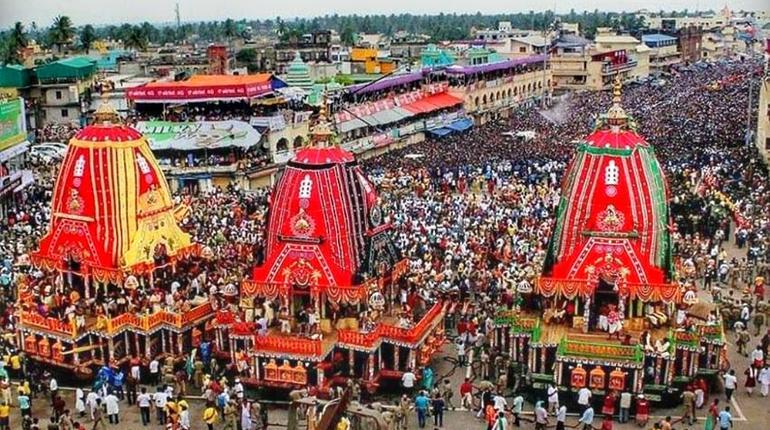
Every year, during this time, the quiet coastal town of Puri transforms into one of the most electrifying spiritual destinations on Earth. Millions of devotees, curious travellers, and photographers descend on this small Odisha town to witness something that has continued, unbroken, for over a thousand years: the Jagannath Rath Yatra.
If you’re planning to make the trip in 2026, this guide will surely help you!
Planning a Trip?
Book Trains
When Is Rath Yatra 2026?
The main Rath Yatra falls on Thursday, July 16, 2026, corresponding to Dwitiya Tithi of Shukla Paksha in the Hindu month of Ashadha. This is the day the three deities, Prabhu Jagannath, Prabhu Balabhadra, and Devi Subhadra, leave the sanctum of the Jagannath Temple and are drawn in their towering wooden chariots to the Gundicha Temple, about three kilometres away along the Grand Road (Bada Danda).
How to Reach Puri
By Air: The nearest airport is Biju Patnaik International Airport in Bhubaneswar, about 60 km from Puri. From there, you can take a taxi, an app-based cab, or a bus — the drive takes roughly 90 minutes outside festival traffic, though expect delays as Rath Yatra approaches.
By Train: Puri has its own railway station, well-connected to major Indian cities. During the Rath Yatra season, Indian Railways typically runs special trains to handle the surge in pilgrim traffic, but seats sell out fast. Book at least a few months ahead if you’re travelling in peak season.
By Road: Puri is connected by national highway to Bhubaneswar (about 60 km) and Konark (about 35 km), making it easy to combine with a broader Odisha itinerary. Buses and private cabs run regularly, though road traffic gets heavy in the days immediately surrounding the festival.
Getting a Good View of the Procession
With millions of people converging on a three-kilometre stretch of road, your experience will depend heavily on where — and how early — you position yourself.
- Arrive hours in advance. Serious devotees and photographers often stage themselves on the Grand Road well before dawn on procession day.
- Upper-floor viewpoints such as Hotel balconies, rooftop cafés, and paid viewing platforms along Bada Danda offer a far more comfortable vantage than standing at street level in the crowd.
- Chariot-pulling is open to everyone! Non-Hindus are welcome to join in physically pulling the ropes and to watch the procession from the road; the restriction is only on entering the temple sanctum itself.
- The Lion’s Gate (Singhadwara) area, where the deities emerge from the temple, is one of the most sought-after and crowded spots, expect tight security and slow-moving crowds.
Safety and Crowd Management Tips
- Keep your group together and agree on a meeting point in case you get separated; phone networks can be unreliable in dense crowds.
- Watch children and elderly family members closely; consider whether they’d be more comfortable viewing from an elevated, less crowded vantage point rather than street level.
- Follow instructions from police and local authorities without exception; crowd control measures exist for good reason on a route this densely packed.
- Stay hydrated and take breaks in the shade; heat exhaustion is a genuine risk during a July festival in coastal Odisha.
- Check official updates closer to the date via the Shree Jagannath Temple Administration (SJTA), since timings and arrangements can shift.
Beyond the Rath Yatra: What Else to See Near Puri
If you’re making the trip, it’s worth building in time after the festival to explore the surrounding region:
- Konark Sun Temple: a UNESCO World Heritage Site about 35 km from Puri, famous for its chariot-shaped architecture.
- Puri Beach: a good place to unwind once the main crowds thin out post-festival.
- Bhubaneswar’s temple circuit: the Lingaraj Temple and numerous other ancient temples make Odisha’s capital worth a day of its own.
- Chilika Lake: one of Asia’s largest brackish water lagoons, known for migratory birds and dolphin-spotting boat trips.
Rath Yatra isn’t just a festival to watch; it’s an experience that rewards preparation. The crowds are real, the heat is real, and the logistics take some planning, but few events anywhere in the world offer this particular blend of scale, devotion, and continuity. Book early, pack light and smart, and give yourself enough time to take in not just the sixteen wheels of Nandighosha rolling down Bada Danda, but the whole stretch of coastline and culture around it.
Jai Jagannath!


