
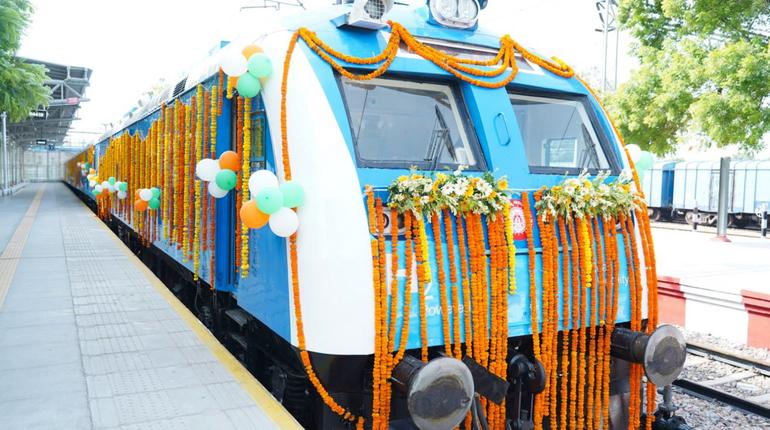
India has entered a new era of clean rail transportation as PM Narendra Modi flagged off the country’s first indigenously developed hydrogen fuel cell-powered train. With this launch, India joins a select group of countries, including Germany, Japan, China and the United States, exploring hydrogen-powered rail technology.
The 10-coach train will operate as a pilot project on the 89-km Jind–Sonipat section of Northern Railway. It is the world’s longest and most powerful hydrogen-powered train, making it a significant milestone in India’s green mobility journey.
See the Tweet Below:
India takes a major leap towards green mobility!
In Jind, flagged off India’s first indigenous hydrogen-powered train between Jind and Sonipat.
This remarkable achievement reflects the ingenuity and dedication of the Indian Railways team. It is a proud symbol of Aatmanirbhar… pic.twitter.com/hVo89u5vvI
— Narendra Modi (@narendramodi) July 17, 2026
India’s First Hydrogen Train: Key Highlights
- The train consists of 10 coaches: 2 hydrogen-powered driving power cars and 8 trailer coaches.
- It can carry around 2,600 passengers.
- Maximum operating speed: 75 kmph
- Design speed: 110 kmph
- It will run between Jind Junction and Sonipat, via Gohana and several intermediate stations.
Safety Features
The train has multiple safety systems, including:
- Hydrogen leak detectors
- Flame detection systems
- Continuous ventilation
- Automatic hydrogen shut-off systems
- Real-time health monitoring for locomotive pilots
The hydrogen refuelling station at Jind will be monitored 24×7, while trained technical personnel will accompany the train during its initial operations.
This pilot project will help Indian Railways evaluate the large-scale use of hydrogen-powered trains while building the infrastructure and expertise needed for future deployment.
How Does India’s Hydrogen Train Work?
Unlike diesel locomotives, the train generates its own electricity onboard using hydrogen fuel cells.
Here’s how it works:
- Hydrogen stored in high-pressure cylinders is supplied to a 1,200-kW Proton Exchange Membrane Fuel Cell (PEMFC).
- Inside the fuel cell, hydrogen reacts electrochemically with oxygen from the air, generating electricity.
- This electricity powers the train’s traction motors.
- A Lithium Iron Phosphate (LFP) battery stores excess electricity and provides extra power during acceleration. It also gets recharged through regenerative braking, improving efficiency and reducing hydrogen consumption.
- The only by-products of this process are water vapour and heat, meaning the train produces no emissions at the point of use.
Hydrogen has an energy density of around 120 MJ/kg, compared with about 43 MJ/kg for diesel, making it a highly energy-rich fuel by weight. Combined with fuel-cell technology, it offers a cleaner alternative to conventional diesel-powered trains.
Hydrogen Refuelling Facility
Supporting the train is India’s largest railway hydrogen storage and refuelling facility at Jind, Haryana.
- Stores nearly 3,000 kg of hydrogen
- Approved by the Petroleum and Explosives Safety Organisation (PESO)
- Built according to international safety standards, including NFPA-2 and ISO 19880
Developed in India under the technical guidance of the Research Designs & Standards Organisation (RDSO), the project is a major step towards cleaner rail transport and India’s transition to sustainable mobility.
Blog Image Courtesy: @RailMinIndia


