destination

1st July - 31st October 2026

Serengeti National Park — Travel Guide

Two million animals, one thundering river crossing — Africa's greatest show runs July to October.

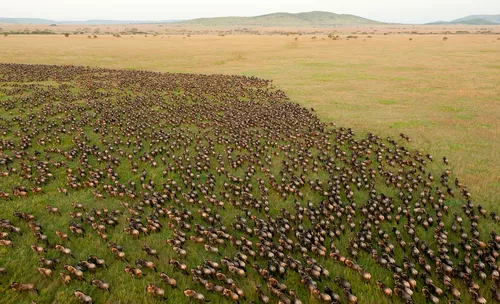
Every year about 1.5 million wildebeest, joined by hundreds of thousands of zebras and gazelles, walk a giant loop between Tanzania's Serengeti and Kenya's Masai Mara. They follow the rains in search of fresh grass. The most dramatic chapter happens between July and October 2026, when the herds reach the Mara river and must cross it to enter Kenya. Crocodiles wait in the water and big cats wait on the banks, so every crossing is a life-and-death drama that plays out in front of your safari vehicle. For Indian travellers this timing is a gift, because the peak season lines up with school holidays and the monsoon months back home. Nairobi is a short overnight hop from Delhi or Mumbai, Kenya needs only an online travel authorisation instead of a visa interview, and a well-planned Mara trip costs less than many people assume. Few journeys on earth reward planning this well.

Nairobi in next 3 month

jan

11/29°C

AQI 24
feb

12/30°C

AQI 38
mar

13/30°C

AQI 38
apr

14/27°C

AQI 38
may

13/26°C

AQI 38
jun

11/27°C

AQI 42
jul

10/28°C

AQI 54
aug

10/28°C

AQI 41
sep

13/28°C

AQI 45
oct

13/30°C

AQI 26
nov

13/27°C

AQI 17
dec

13/26°C

AQI 18

August in Nairobi continues with cool temperatures, occasional rain showers, and improved air quality.

Usual trip duration

3-4 days

A 3-4 day trip to Nairobi allows you to explore the city's rich culture, visit the Nairobi National Park for a safari experience, and take a day trip to the nearby Giraffe Centre and David Sheldrick Wildlife Trust.

Moderate to expensive

Nairobi offers a range of pricing for tourists, with moderate options for accommodations, dining, and transportation alongside more expensive choices in luxury hotels and upscale dining. Prices can vary based on the season and specific preferences, but overall, Nairobi can be considered moderately priced for travelers.

Prices can vary based on the season and preferences.

Interesting facts

The migration involves roughly 1.5 million wildebeest along with several hundred thousand zebras and gazelles, making it the largest overland mammal migration on earth.

The herds cover a loop of about 800 kilometres a year, and an estimated 250,000 wildebeest do not survive the journey due to predators, exhaustion and river crossings.

During the calving season from January to March in the southern Serengeti, hundreds of thousands of calves are born, with several thousand arriving on peak days.

The migration was named one of the Seven Natural Wonders of Africa, and it never actually ends — the herds are moving somewhere every single month of the year.

A wildebeest calf can stand within minutes of birth and run with the herd within a day, which is essential when lions and hyenas shadow the nurseries.

Do’s and Don’ts

Do pack neutral colours like khaki, olive and beige; bright clothing can disturb wildlife and dark blue or black attracts tsetse flies.

Do start anti-malaria precautions before you fly; consult a travel clinic about prophylaxis and carry a DEET-based repellent.

Do carry a yellow fever vaccination certificate; it is strongly recommended for Kenya and some airlines ask for it.

Do book Mara camps 6–9 months ahead for July–October; migration season sells out faster than Diwali train tickets.

Do carry binoculars and keep your camera ready at crossings; the wait can be hours but the action lasts minutes.

Do carry some US dollars in cash for tips and park-adjacent purchases; cards work at lodges but not everywhere.

Don't expect a crossing on demand; herds can mass at the river for days before they jump, so build in at least three nights.

Don't stand up, lean out or ask your driver to go off the designated tracks; rangers fine vehicles and it stresses the animals.

Don't carry drones; they are banned in Kenyan parks without special permits.

Don't rely on vegetarian food being available everywhere; inform your camp in advance, as most happily cater to Indian vegetarian and Jain meals when told early.

Don't forget warm layers; Mara mornings in July–August can drop below 10°C even though it is Africa.

Don't buy wildlife products like bone or skin souvenirs; it is illegal and checked at airports.

Budget Breakdown

Travellers

0
1
1

Days

0
6
6

Flights

₹40,000

Stay

₹35,000

Local Transport

₹12,000

Dining

₹8,000

activities (game drives + park fees at US$200/day peak; balloon extra)

₹75,000

Visa

₹2,950

Total Estimated

₹172,950

Visa Details

Visa Starting From
₹2,950
Get Visa In
1–3 days
Documents Required:
Passport
Photographs
Return flight tickets
Hotel bookings
Payment card

Things to do

All
wildlife
museum
nature
park
crafts
shopping
art
history
recreation
Nairobi National Park

4.5

Nairobi National Park

WILDLIFE

Wildlife in the city
David Sheldrick Wildlife Trust

4.6

David Sheldrick Wildlife Trust

WILDLIFE

Orphaned elephant rescue
Giraffe Centre

4.6

Giraffe Centre

WILDLIFE

Up close with giraffes
Karen Blixen Museum

4.4

Karen Blixen Museum

MUSEUM

Home of Out of Africa author
Nairobi National Museum

4.5

Nairobi National Museum

MUSEUM

Cultural and natural history
Karura Forest

4.7

Karura Forest

NATURE

Tranquil green space
Uhuru Gardens

4.3

Uhuru Gardens

PARK

Historical public park
Nairobi Railway Museum

4.4

Nairobi Railway Museum

MUSEUM

History of Kenyan railways
Kazuri Beads Factory

4.5

Kazuri Beads Factory

CRAFTS

Handmade ceramic beads
Nairobi Aviation Museum

4.5

Nairobi Aviation Museum

MUSEUM

Vintage aircraft collection
Nairobi Safari Walk

4.4

Nairobi Safari Walk

WILDLIFE

Educational wildlife experience
Nairobi Snake Park

4.4

Nairobi Snake Park

WILDLIFE

Variety of snake species
The Village Market

4.6

The Village Market

SHOPPING

Upscale shopping and dining
Nairobi Gallery

4.4

Nairobi Gallery

ART

Historic art collection
Nairobi National Archives

4.2

Nairobi National Archives

HISTORY

Preserving Kenya's history
Nairobi Ice Rink

4.6

Nairobi Ice Rink

RECREATION

Indoor ice skating
Nairobi Roller Skating Rink

5

Nairobi Roller Skating Rink

RECREATION

Family-friendly fun

Restaurants

CJ's

4.6

CJ's

The Carnivore Restaurant

4.5

The Carnivore Restaurant

CJ'S - Kilimani

4.6

CJ'S - Kilimani

Fogo Gaucho Westlands

4.6

Fogo Gaucho Westlands

bamba

4.7

bamba

Cultiva Farm Kenya

4.7

Cultiva Farm Kenya

Ankole Grill Kitisuru

4.6

Ankole Grill Kitisuru

The View

4.7

The View

Talisman Restaurant

4.6

Talisman Restaurant

Mawimbi Seafood Restaurant

4.6

Mawimbi Seafood Restaurant

Nairobi Street Kitchen

4.5

Nairobi Street Kitchen

Zen Garden

4.5

Zen Garden

La Terrazza Italian Restaurant

4.5

La Terrazza Italian Restaurant

Harvest Restaurant

4.5

Harvest Restaurant

beit é selam

4.5

beit é selam

The Sage Delicacy

4.5

The Sage Delicacy

The Grove Restaurant

4.5

The Grove Restaurant

Urban Eatery

4.4

Urban Eatery

Seven Seafood & Grill

4.5

Seven Seafood & Grill

Peppertree

4.5

Peppertree

Explore more

Frequently Asked Questions

When is the best time to see the wildebeest migration in Masai Mara?

August and September are the most reliable months for river crossings in the Masai Mara. The herds usually start arriving from the Serengeti in July and begin moving back south by October. Crossings cannot be predicted to the day, so plan at least three nights in the Mara.

How much does a Masai Mara safari cost from India?

A realistic 6-day trip costs about ₹1.7 lakh per person on a budget shared safari and around ₹2.9 lakh for a mid-range trip with tented camps. Luxury fly-in safaris start near ₹6 lakh per person. Flights, park fees and the eTA are the fixed costs; accommodation is where budgets swing.

Do Indians need a visa for Kenya?

No traditional visa is needed; Indians apply online for Kenya's Electronic Travel Authorisation (eTA). It costs about ₹2,950, needs only your passport, photo, flight and hotel details, and is usually approved in 1–3 working days. Apply at the official portal etakenya.go.ke.

Is the Masai Mara safe for Indian tourists?

Yes, the Mara and the standard Nairobi tourist circuit are well-trodden and safari operators handle logistics end to end. Take normal big-city precautions in Nairobi, avoid walking alone at night, and inside the reserve always follow your guide's instructions. Thousands of Indian travellers visit during the migration every year.

Which is better for the migration, Masai Mara or Serengeti?

For July to October, the Masai Mara offers the famous Mara river crossings in a compact area, and Kenya is the simpler route from India. The Serengeti is better for the calving season from January to March. Many serious safari-goers eventually do both, but the Mara is the natural first trip.

How do I reach Masai Mara from Nairobi?

You can drive in 5–6 hours by safari van or 4x4, or fly in about 45 minutes from Nairobi's Wilson Airport to a Mara airstrip. Driving is cheaper and shows you the Rift Valley; flying saves a full day across the trip. Most budget packages drive and most luxury camps fly you in.

Are there direct flights from India to Nairobi?

Yes, Kenya Airways flies non-stop from Mumbai and Delhi to Nairobi in about 6–7 hours, with return fares typically between ₹40,000 and ₹60,000 in migration season. One-stop options via Gulf hubs like Dubai and Doha are often cheaper if booked early.

Is a hot-air balloon safari worth it in Masai Mara?

Most travellers who do it call it the highlight of the trip, because you float over the herds at sunrise and land to a bush breakfast. It costs roughly ₹38,000–₹48,000 per person (about US$450–550), so treat it as an optional splurge rather than a must.

What should I pack for a Masai Mara safari in August?

Neutral-coloured clothes, a warm fleece or jacket for sub-10°C mornings, sunscreen, a hat, binoculars, insect repellent and any prescribed anti-malaria medication. Soft duffel bags are required on small fly-in planes, which also cap luggage near 15 kg.

Can vegetarians manage food on a Kenyan safari?

Yes, comfortably, if you inform your camp or tour operator in advance. Most Mara lodges cook fresh vegetarian dishes daily and many operators who host Indian groups offer dal, rice and roti style meals. Carrying some packaged snacks from home is still a good backup for drive days.

Is yellow fever vaccination compulsory for Kenya from India?

Carry the certificate to be safe. Kenya recommends yellow fever vaccination for travellers and many airlines and Indian re-entry checks ask for it. Get the shot at a government-authorised centre at least 10 days before you fly, as that is when the certificate becomes valid.

How far in advance should I book a migration safari for 2026?

Six to nine months ahead is ideal for July–October 2026, because riverside camps run small and sell out first. For this year, book the moment your dates firm up; last-minute travellers usually pay more and stay farther from the river.
playstore
appStore

© 2026 Le Travenues Technology Ltd. India. All brands are trademarks of their respective owners